
TRADING BOTS
Get the top algo trading bots (EAs for MT5) here.
Forex Panda is a specialist in Algo trading and Copy Trading. We use our own bots.
INDICATORS MT5
Free indicators, dashboards, and other useful tools.
Advancing your trading results. Available at the MGL5 Shop.
Market Update & Blogs
Stay up to date and learn about the latest trends and cutting-edge developments. Only an up-to-date trader is a good trader.
By FOREXPANDA.NET
Most traders who fail a prop firm challenge do not fail because of a bad strategy. They fail because they misread the prop firm drawdown rules. One oversized position, one bad day or one losing streak is enough. As a result, the account is closed and the fee is gone.
This guide turns the rules into numbers. Firstly, you will see how much you can lose. Secondly, you will learn how much to risk per trade. Finally, you will calculate your lot size for forex and gold. Do you also use an EA on a challenge? In that case, read our guide How to Pass a Prop Firm Challenge.

Prop firm drawdown rules: the two limits that end most challenges
Most challenges end because of two limits.
- Daily loss limit. This is the most the account may lose in one day. However, firms measure it differently, for example from the starting balance or from equity. The time zone and floating losses can matter too.
- Maximum loss (max drawdown). This is the most the account may lose overall. It is either static or trailing. A static limit is a fixed floor below your starting balance. In contrast, a trailing limit rises when your balance or equity reaches new highs.
Because rules change, always read the current rulebook on the firm’s website. The examples below use a $100,000 account with a 5% daily loss limit and a 10% maximum loss. However, these numbers only show the math.
Step 1: Turn the limits into dollars
- Daily loss limit: 5% of $100,000 is $5,000.
- Maximum loss: 10% of $100,000 is $10,000. Therefore, the account must stay above $90,000.
- Trailing example: if you grow the account to $104,000, the floor can rise from $90,000 to $94,000.
- Some firms stop trailing at the starting balance. For this reason, check the rules of yours.
Your real risk window is the distance to the nearest limit, not the size of the account.
Step 2: Choose your risk per trade
This table shows how many full losing trades it takes to reach each limit. However, it ignores compounding and assumes every loss has the planned size.
| Risk per trade | Dollar risk | Losses to hit 5% daily limit | Losses to hit 10% max loss |
|---|---|---|---|
| 0.25% | $250 | 20 | 40 |
| 0.50% | $500 | 10 | 20 |
| 1.00% | $1,000 | 5 | 10 |
| 2.00% | $2,000 | 3 | 5 |
Every strategy has losing streaks. For example, at 2% risk, three losses in a row can end your day. In fact, that is very common. Therefore, many traders stay at 0.5% to 1% or lower. In the end, the right number depends on your strategy’s losing streaks and on your firm’s limits.
Step 3: Calculate your lot size
Because the formula is the same for every instrument, you can use it for forex and gold.
Lot size = dollar risk ÷ (stop-loss distance × value per 1 lot).
Example 1: EURUSD
You risk 0.5% ($500) with a 25-pip stop. One pip is worth about $10 per standard lot on USD-quoted pairs. As a result, lot size = 500 ÷ (25 × 10) = 2.0 lots.
Example 2: Gold (XAUUSD)
You risk 0.5% ($500) with a stop $8 away from entry. On most brokers, 1 lot of gold is 100 ounces. Therefore, a $1 move equals about $100 per lot. However, pip definitions for gold differ between brokers. For this reason, use the price distance and check your broker’s contract size.
As a result, lot size = 500 ÷ (8 × 100) = 0.62 lots. Always round down, never up.
Set the stop first, then calculate the size. Otherwise, you may choose a lot size first and place the stop wherever it fits.
Step 4: Set your own daily stop, tighter than the firm’s
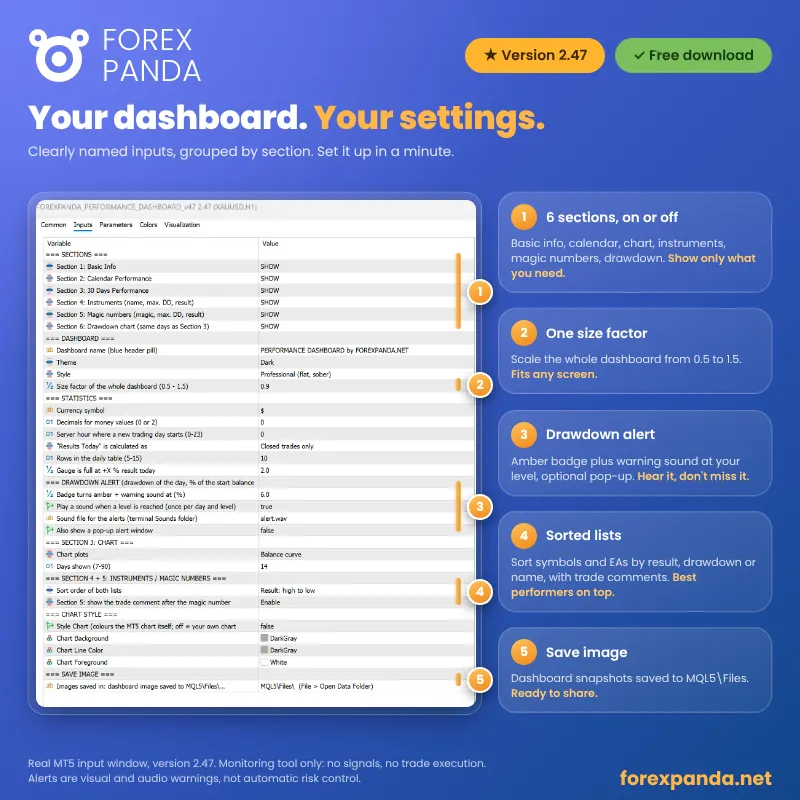
The firm’s daily limit is where the challenge ends, not a target. Because slippage, spread spikes and gaps can make a loss bigger than planned, you need a buffer. On the example account, a personal daily stop of 2% ($2,000) means four full losses at 0.5% risk. After that, you are done for the day. As a result, $3,000 of room is left for the unexpected.
An alert makes this easier, especially in fast markets. The free Forex Panda Performance Dashboard has an optional drawdown alert. It shows an amber badge and plays a warning sound. This happens when your drawdown for the day reaches your chosen level, for example 1.5%. However, it is only a warning, not automatic risk control. Therefore, you still have to stop trading yourself.
Floating losses and equity
Many firms measure the daily limit on equity. Therefore, an open trade that is deep in the red counts against you before you close it. Likewise, if you run several positions, add up their combined risk. For instance, three trades risking 0.5% each are a 1.5% risk if they all move against you together. This is especially true for correlated pairs such as EURUSD and GBPUSD.
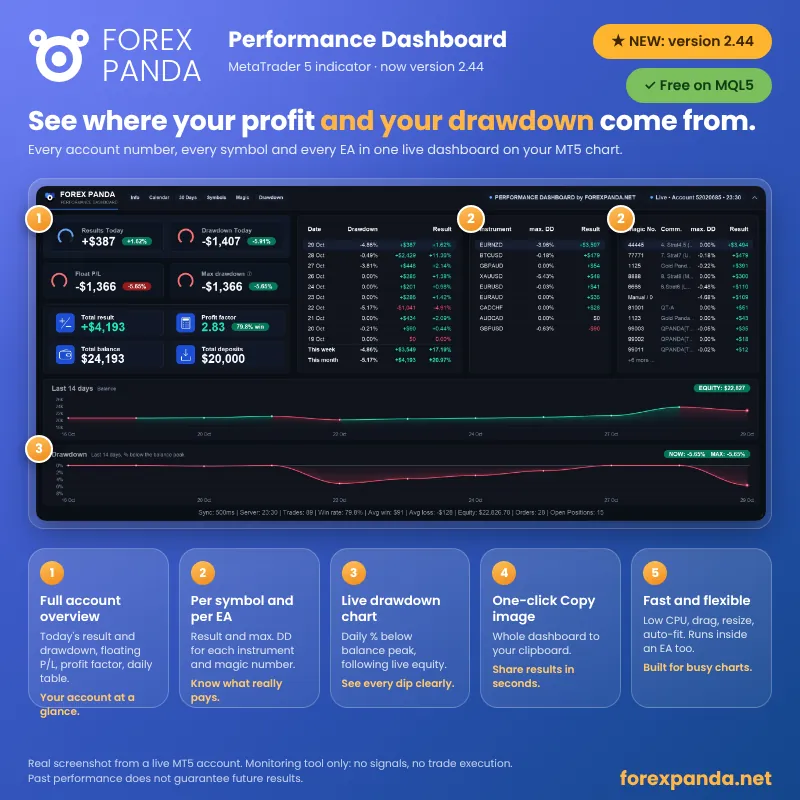
During the day, check your floating P/L, today’s drawdown and max drawdown, not only after you close your trades. In addition, the Dashboard shows all three on one panel (see the picture).
Quick pre-trade checklist
- Do I know today’s remaining daily loss budget in dollars?
- Did I place the stop-loss first, at a level that makes sense for the market?
- Does the risk on this trade, plus all open trades, stay inside my personal limit?
- Could high-impact news that my firm restricts widen the spread soon?
- Have I rounded my lot size down, not up?
Common mistakes
- Sizing trades against the account size instead of the distance to the limit.
- Raising risk after a loss to “get it back”, which is revenge trading.
- Forgetting that floating losses count on equity-based rules.
- Using maximum leverage just because the firm allows it.
- Not knowing whether the maximum loss is static or trailing.
Track your numbers while you trade
The math only helps if you can see your numbers during the day. For this reason, we built the free FOREXPANDA Performance Dashboard for MT5. It shows today’s result, today’s drawdown, floating P/L and max drawdown on your chart. In addition, it shows profit factor, win rate and a live drawdown chart. Finally, a daily calendar adds weekly and monthly totals. However, the Dashboard is a monitoring tool only. It gives no signals and places no trades.
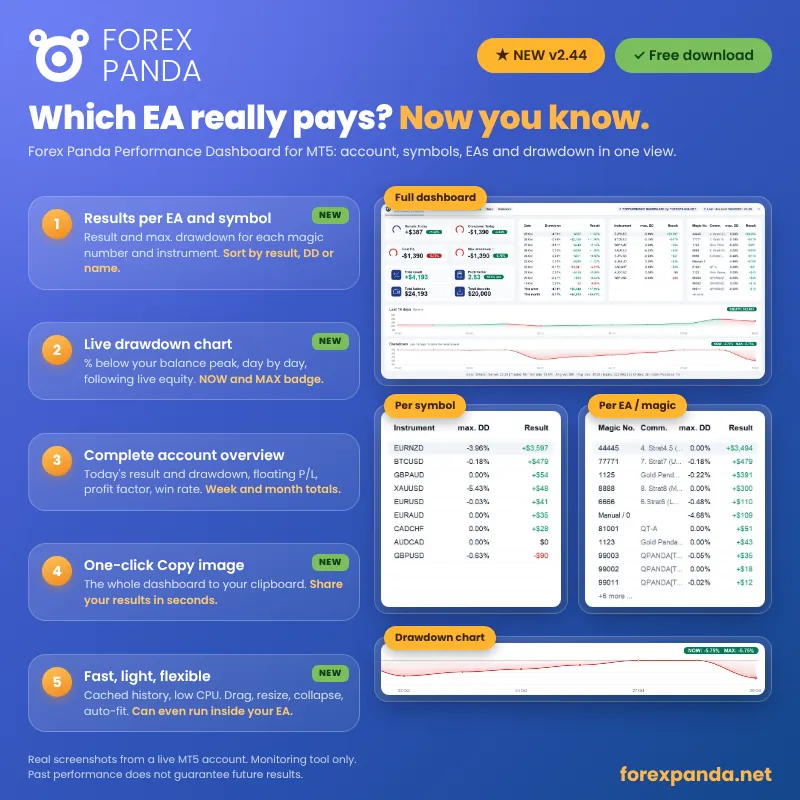
Which EA or symbol is using up your drawdown?
Do you run more than one EA, or trade several symbols on one challenge account? In that case, the Dashboard shows the result and max drawdown for each symbol and each EA (by magic number). Besides, you can sort the lists by result, drawdown or name. As a result, you quickly see which one is using up your drawdown budget.
FAQ
What is a safe risk per trade for a prop firm challenge?
There is no universal number. Many traders use 0.5% to 1% or less. Therefore, use the table above to check how many losses in a row your account can survive.
What is the difference between static and trailing drawdown?
A static floor stays fixed, for example $90,000 on a $100,000 account. In contrast, a trailing floor moves up when your balance or equity reaches new highs. As a result, winning trades also reduce your room.
Do floating losses count toward the daily loss limit?
At many firms, yes, because the limit is measured on equity. However, rules differ, so read your firm’s rules to be sure.
Can I use bigger lots to pass faster?
It is possible, but it is dangerous. For example, at 2% risk, three losses can breach the daily limit. In fact, passing slowly is better than failing fast.
Can I get a warning before I hit my daily limit?
Yes, a drawdown alert can do this. The one in the free Forex Panda Performance Dashboard shows a badge and plays a sound when your daily drawdown reaches your level. However, it only warns you and does not close trades.
Risk disclaimer: Trading forex, gold and CFDs involves a high level of risk and may not be suitable for everyone. The numbers in this article are examples, not recommendations. Because prop firm rules differ and change, always check the current rules of your firm. Past performance does not guarantee future results. Nothing here is financial advice.


